WENT UP
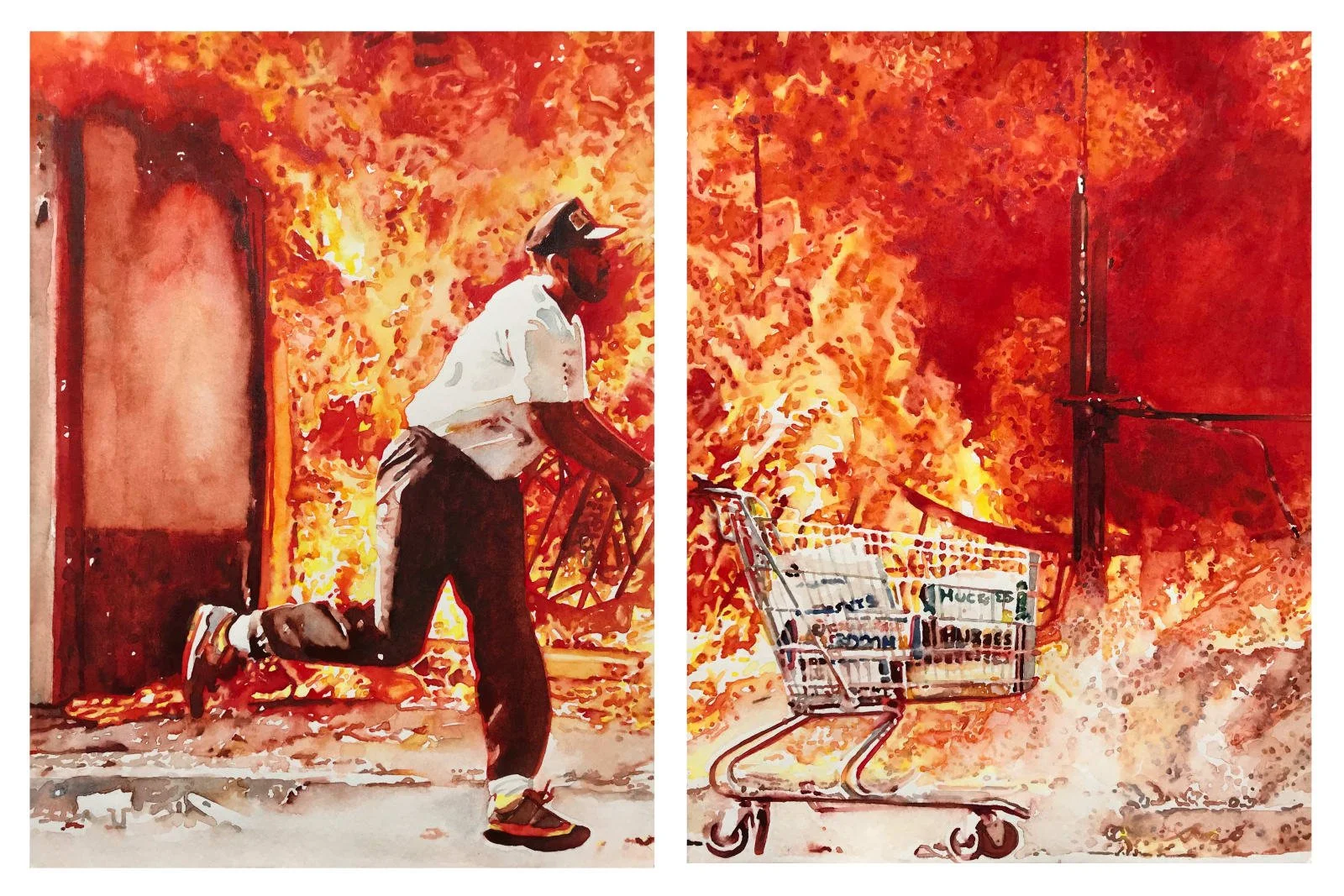
Variegated streaks and flickering scarlets danced on the body, turning it first a subcutaneous yellow as the styro slid from his underarms, the currents of waterless ripples on his skin, as his skin, merging and melding like a new form of hygiene. This jaundiced urge overtaking him, the sight of sulphuric whirlpools that managed to amalgamate the body, define and redefine each contour of him, merge and unmerge each separate layer of clothing. Linen, cloth, corduroy, denim, flesh; all caught in an infernal dance, all superimposed over the jagged sheen of metal. A new colour wrought out onto the frame. Next was black. It always was. The flames revealed and then obscured his body, oscillating between the two as the previous forms of clothing gave way into one, shameless and formless vibrato. Strings and wires of grey concrete whispering from the frame. He was tenebrous then–veiled only under the flickering tongues, pulled like a marionette by the waft of scrawled grey graffiti above him. I wanted to see the moment that his striated chest started to snap like garrote wire. I wanted to see the fire fry his last nerve endings, giving way to a silent, ineffable ecstasy; a statement against the dualism of his mind-body, a statement against the Enlightenment conception of nature-culture. All things lineated, classified, materialised, could go up with him in smoke.
Most of all, I wanted to pinpoint that moment where he would smile, if he could, if he wasn’t caught melting. A ghostly exhale of his last essence, his nefesh, that Hebrew word for both life and breath; caught slightly out of his body in the transcendent stasis of my own, forgiving spacebar. And so I had pulled back the white line, rewinding the video to find that moment of revelation, the moment where his soul and body were two, separate things. A glance around the prose of his desiccated self, his saintly new frame caught suspended between the shaking, held by me from the moment of separation. My own Saint Apollonia, protected by my own need to see his truest, innermost split-second, a vestal for my own viewing, a vestal pouring herself out onto her hearth, the hearth pouring itself out onto her. An incessant poise and counterpoise between extrication and smothering. I wanted to find something. But nothing. I rewound it again, and again there was nothing but melting. I turned my phone off–seeing my reflection in the black glass–and put it on the armrest of the sofa.
The gulls were boiling in the sky. I turned from the sofa and placed my hand on the bay window, feeling the rubber creases of the sills gradually falling apart. That big ‘X’ shape on the glass had started to melt too, with the seams peeling off to reveal little gaps to the world outside. I thought of time. How long would it take before the seams finally came undone, the heat unsticking the panes like bad glue, letting the chaos outside in?
I made calls but no one cared for window repairs. I thought of leaving but it seemed more ethical to stay. To try and focus.
I looked through the window, towards the small, communal garden. It was one of those boxes of green designed to offset urban decay, with the grass always cut, but by no one in particular. In fact, I had never seen anyone use it, not even the tenement opposite, where the bodies of sweating men were constantly going in and out. They often left the door to the house open, and I’d watch the empty space that spits random men from its mouth. Even they had never unlatched the door to the garden, they rarely even looked. It was just a small perimeter of green, boxed in and sweating under the sun.
I sat behind the window for a long time. Eventually, a gull landed amongst the grass and staggered about, drunk under the sun. It was searching for grass but finding cracked soil and arid pavement. Eventually, resigned to its fate, it laid down in the shadow of an iron balustrade, poking at the holes in the earth for a last time.
I picked up my phone, a reflex by now. It reflected on my face for a second before I unlocked it and started scrolling.
The world was a series of dry, featureless scars, concave keloids that had sunken into the thin membrane of the earth. The topological perforations of the world were moulded when this-or-that ocean had started to dry up. And people would chase after it. Meandering columns of thirst would retreat into the crevices of what was once seafloor, like scars lined with mouths, all delirious from the sunstroke. An ambiguous mass of people, made univocal only by the jittery movements of the hands as they pushed and shoved; up by the void above their necks.The Gobi, Sahara, Patagonian, and Syrian, which had once been deserts, were now marked in the collective societal consciousness as temporal abnormalities. Places from which all would return, all be united with. They just happened to do it first. I once saw a desert basin, which, now an indistinct noun, was already the granitised relic of an outdated language. But in the videos, it was all made of mouths. Gurning on gums, chewing, dried up husks. The matter of narrating it, with its droll banality now, seemed a grammatical mistake, an error of predicative fit. But, to focus, back when the entrance to the human face appeared as an intimate or spiritual connection, I’d watched as starry formations of F-35 fighter jets flew in asynchronous bursts alongside Northrop B-2 bombers and constellations of Xian H-6’s. Bleating comets ripped against the firmament of the atmosphere, trying selfishly to find a flight out.
Back down, the camera showed writhing flames. I watched a certain order form to it, the subjects of the cameras clamouring into a staircase of charred, grasping limbs, reaching out their hands at those same atmospheric constellations. There, the inherent breathlessness of crowds squeezed into shapes denied me of any reprieve. A strange sense struck me, explicated only with the following Latin: mens sana in corpore sano. Means ‘a healthy mind in a healthy body’. The constricting asphyxiation of crowds on my screen, both followed and preceded by more videos of similar events across the world, on the news, on each channel, in each polite conversation, as a conversation starter, pointed me only towards an inevitable conclusion. And this conclusion was that these desertified lands were a new hygiene, a purity previously undiscovered, a kind of collective bacchanalian whorl around something I’d associated only with Manson or Branch Davidian deserts, peripheral stories of violence in the old world. But in the new, even violence was outdated; it implied a relation between subject and object, a struggle between two parties, where things had gone far beyond that. Humans were united by thirst.
In any case, I hadn’t drunk for years. I rewound that video until my thumb started to cramp, just trying to find that moment where the faces inside the jets had produced tears. Maybe one of the pilots would say something, in military jargon, slightly adjacent to guilt. Maybe it’d be a line about collateral damage or the selfishness of attempting to exit the stage. Maybe it’d be a lie about how the starry days had bleached even the underside of dotted C-130 Hercules or boat-hulled Sikorsky S-61L’s—that even war had shrivelled up alongside the oceans. But, point is, it never came. I scrolled, pausing on a still man. It was before the bursts of white and all I could see, all that I could focus on, was his lack of teeth. His mouth was a void, a black hole unprepared to drink up the fire.
Rewind-rewind-rewind. Nothing.
I turned my phone off once again and felt around for my own teeth. They were still there, which was good, but I hadn’t managed to start salivating again. My mouth was a jagged cliffside, dry as granite. An arid border that produced scarlet blood with each touch.
Your home is your castle, the saying goes, and I’d found that organising the lounge helped with the outside world and its swirling bacchanalia. So that’s what I did. I got the all-purpose lemon cleaner, Tescos, wiping it longways on the fake grain of the laminate, watching for germs, for sheen, for the plastic lines of pretend oak to stretch out into lines. Nothing. I unstuck the flies from the glue—their bodies coming off in one go, legs left like runoff words, the hum of wings quickly silenced by an empty, desiccated set of stringers. I reorganised the cupboards, turned the fans on, opened the windows, turned the fans off. Nothing stopped the sun shining. I was sweating because of course I was sweating. I mean, it was hot.
More movement, cleaning, tidying, organising. More classifying, judging, trying to kill the time. In long side unit, a photo of a distant cousin was placed next to a psychiatry textbook. Miles Davis vinyls had been put into one of the cubes diagonally, squashed in with an 8-track tape. All the music paraphernalia went into one, designated space. That’s how she had always liked to organise things, as if there was an imaginary rubric that she could see, floating above the squares, saying Music, that should go here, cousin stuff here. I didn’t know that my cousin was a nurse until that one trip to the hospital, but I could see it, in that way that we figure out our families by guessing. By making up stories. By getting drunk to make up stories. It’s what we have to do in order to figure out where we end. And sometimes things ended because of it. I checked the miscellany of items on the TV stand and compared them with the photos. Fake money plant–check. Minimalist lamp—check. Speaker–check. Something was missing.
A taxonomic calm. A juddering feeling of forgetting.
Twenty-six more people went up in London in the time it took to clean the living room. BBC news, ITV, Sky, the litany of blaring American news shows with their pomp and their incessantly flirty accents. The papers had stopped reporting on most of it directly. Obituaries outpaced the positional logic of a broadsheet, fonts were decreased, names were shortened, words excised. But it was what they were calling it now. Went up, Going up, Setting on—as if the word fire might be haunted, a strange, mystical attraction to an abstracted flower as it blossomed upon your shoulders, invited you in, spat you out. And a solemness about the whole situation, solemn of course meaning both ceremonial and threatening. To view it though. All in a static few seconds…
On YouTube, each video had a different comment section, with a thousand different interpretations. I scrolled.
Some guy on a podium was talking about an ancient Palestinian light reaching out to us all, a law of faith that made a worm die at night. His gestures changed from erratic, expressive bursts on the evangelical joy of life down to solemn sways. He touched his chest, his face contorted into a whitened snarl, an attempt to fight the sweats that appeared on his brow. An increasing and ironic austerity about his own mannerisms, I wondered what he might be seeing, the dilation of his pupils, the feeling inside of him (if he might admit to such a thing). I wondered about his neurology, synapses firing and misfiring, connecting, fraying. The next shot. The stage a sepulchre of neon lights. A view of the audience, there as structurally inert props, entranced by the pending event; simultaneously caught in anticipation and a withheld facade of non-anticipation. One had to pretend not to pretend. And in one frame, the long, circuitous route of faking a disgust to conceal an attraction to fake a disgust to conceal an attraction showed itself in an infinite and visible regress. Eyes, and I counted each eye, fourteen in the shot, stared off to the right hand side of the camera, towards their pastor. And their eyes were whirlpools of granite. The rest of their prop-ness was nothing.
I think it started in his heart given the way that his tie set fire first, wherein he poorly quoted Agua Viva: the world has no visible order and all I have is the order of my breath in between prayers for forgiveness, Pauline ideas he’d half-forgotten as he charred. Seemingly more reactive to the onlookers, I felt no particular urge to hang him in the suspense of a spacebar, and roved over thumbnails of ‘related videos’ as the expression on his face bored me at last. The aridity of the ironic presentation meant a great deal of nothing. And though it had some uninspired title: pastor gets a taste of his own medicine!!! I saw a particular effortlessness in interpreting this as hell. I saw a few dozen similar videos.
What was missing? What was I waiting for? What would justify my attention?
A camera showed the last spools of thin, stagnant water, a shape more gelatinous than it used to be, the colour of scum. Gasps of an American great lake. It was surrounded with tarmac and tarpaulin, victimised by trowels and troughs, dug out and surrounded by fences which themselves were supplemented by an inner ring of industrial machinery—ThyssenKrupp excavators, Ford backhoes, a general wash of yellow. In the foreground, a man sat alone on the rocks of a cliffside, jittering into his 240p camcorder, the sound of someone trespassing. When he talked, only his beard seemed to move, overgrown and discoloured. He monologued about it entering his body—it’s pure light, nothing else can compare! The low quality dulled the colour of the background cliffs into a dark sepia, a topology of waiting. An implication of a coming exposure to light. Grains of greys and browns filled my eyes as he stepped backward from the screen, a poor ISO or genuinely grainy footage, the negative space then suddenly replaced with bursts of white. He didn’t shake. He might’ve fallen asleep standing up as the flames possessed his body. Blocks of flesh combined with his clothes, obscured and revealed with the spasmodic dancing of the fire, closer and further. Like love, going up was always defined by the interplay between intimacy and distance. It was a dance I found Romanesque. That is, it recalled Vitruvius’ Roman genealogy, that civilisation was a project of buildings, that buildings were necessitated by the urge to contain fire, and that man’s relation to fire was one, permanent interplay between that intimacy and distance. Too close or too far. Never a distance where they didn’t suffer.
Anyways, I watched as the 99% linen military cuff melded with his skin and then melted away. He was the first one I saw go up, it was strange that I was seeing it again.
I had read the comments like scripture. I heard it was a molotov thrown by some blue-collar scabs in response to something (plug in any reason). I heard he was prodromal, that it was a symptom of (plug in any reason). I heard ecological terrorism, flights from the mothers body, and Lacanian ideas of lack quoted badly by anime avatars before they themselves were affected. It’s because there’s something inside of him, the message I took from one comment chain. Dull. It was vaguely religious, psychoanalytic, another moralising invocation of an eternal and obliterating sterility. Always new events to map out into the language of purity, a need to classify all into a box, to make all eloquent and rational. A grammar wherein people have insides that need to be filled. It seemed pointless to me, to try and get inside the pastor’s head, to form and reform a language from inside of him. Pointless and pointed, by that I mean, a desperate attempt to pierce a dead man; violent, unethical, a return to the same…
I had got into a comment section argument, which is never good, but I was trying to make the point that fire was on his exterior, a foreignness to his self. I concluded by arguing that it was the outsides going in, not the inverse, which characterised him going up. No response. Content with arguing my case over a screen, I was disappointed by being left hanging, left only with the various layers of meditating screens.
Thoughts: a set of circular ironies had found their way back to mankind on my phone screen, Vitruvian logic splayed back onto itself, an immolative return. The avatar on the other end of the comments had posted back, talking about castration or something, and mentally I had checked out by then. The draining of the circuitry of the body was a fuzzy idea to superimpose out onto a drained, empty world. People did anything to talk back around about thirst, drinking, piercing, classifying the ashes of those lost…
But the end of the world had an ability to outpace the urge to squish it into language. The spontaneous fires existed outside of humankind’s need to fit all things into a coherent line.
I’d gone back to dissect each frame, staring into my phone in hopes that one pixel might hold the revelation I was looking for. Maybe it’d be the frame where he spoke, but what did he mean? Maybe it’d be the frame where his eyes closed–what would that tell me? I watched and rewatched, waiting for that moment where the fire might finally pierce me, where I would understand or at least care. It didn’t come. It was the beard, and only the beard, that I really cared about. The way that it didn’t move as he monologued. The way it coiled as he burned, turning a cracking black, with his mouth shut the whole time. The permanent and asphyxiated quality of hairs being singed, or the painful breaths of a man suddenly not quite used to swallowing. Revelation rhymed with Genesis. Only poets accurately gauged the state of things.
The inscriptions of bright bursts around him, upon him, as him acted to me as an affirmation. A proof for a logic against the dogmatic classifying of things. There was no border between mind and body anymore, no differentiation between nature and culture. Bic lighters went up in the same direction as Venus flytraps, Venus flytraps in the same direction as human beings. The sky was a permanent golden hour. All was a surface upon which the palimpsest of volcanoes erupted ex nihilio. Great bursts of nothing, going up, setting on. All I saw conveyed only a solvent against false distinctions, a revelation against revelatory energy. The process was boring to discuss. It only made sense to watch.
A paper I’d read around this time was entitled ‘Fission and expenditure: residual affect-logic in sampled material’. I didn’t understand much of it. But from what I did understand was that a team of researchers found a set of manifestos of those affected which held particular salience. They investigated this. Surveys were conducted in the form of interviews with the bereaved. In total 3,111 people were involved and 219 interviews conducted. The themes that seemed to be brought up several times went as follows: work/life balance, emotional affect before exposure/after exposure, pharmacological involvement, religious belief, political belief. Of the saliences discussed, the team of researchers found correlation between comorbidity (those interviewees who later went up themselves) and their emotional affect. The researchers put forward the idea that emotional affect was linked to going up. More research was to be conducted before reaching any conclusion though. Just waiting.
Outside my window, circles of grass had singed into a greaseless yellow, the colour of waning light, forming spiral shapes. I’d stared at it for long enough for my eyes to lose focus, a low-quality camera, and the grass outside had looked more like a Tabriz rug. Withered flowers on the outside, and there, further inwards, I saw rings and rings of husky yellow and dull greens. A mandala. I looked. And there was a sensation that the rings too were inviting me in, looking at me too. The more my eyes lost focus, the more the crusted scum-grass enfolded, enveloped my sight. It was a feeling like receiving a gift: faint, a fading consciousness, an inbuilt mechanism within me that told me to run away. I drew curtains from the window and sat down, suddenly dizzy. The sun still stood in the air. All was still. A homeostasis.
by Liam Chimba
Liam Chimba (He/Him) is a graduate of Creative Writing and Philosophy from the University of Chichester. He lives on the East coast of England.